Showing posts with label capitalism. Show all posts

A High Stakes Clash of Economists

Diposkan oleh Zainal Arifain


By Alan Caruba

“We need an impulse, a jolt, an acceleration…Let us experiment with boldness on such lines, even though some of the schemes may turn out to be failures, which is very likely.”

Who said that? Was it President Obama? Franklin Delano Roosevelt? Neither. It was John Maynard Keynes, a British economist. The year was 1924 and England, still struggling to recover from the cost of World War One, was trying to figure out what steps to take. The British economy was suffering from high interest rates, falling prices, and high unemployment.

Keynes’ view was that the government had to spend lots of money on public housing, better roads, and improvements to the electricity grid to get money into general circulation, stimulate the economy, and restore business confidence. The unemployed had to be given work even if it was the government not private enterprise that would provide the capital.

Keynes was already world famous because of his role as a British Treasury negotiator at the Paris Peace Conference, a precursor to the Treaty of Versailles. He had written a book, “The Economic Consequences of the Peace”, that revealed the disastrous path the treaty has set Europe upon, the beggaring of Germany and Austria that led to the rise of Hitler and World War Two.

His economic theories would eventually take his name and, ultimately, his magnum opus, “A General Theory”, would enshrine him in the pantheon of the most famed economists. Succeeding generations of economists and even politicians would call themselves Keynesians.

A quite thoroughly unknown economist, Friedrich Hayak, an Austrian who was sixteen years younger, took a far different view. While Keynes thought economics must be applied to improve the lives of people through government programs, Hayak thought that the less government interfered with the free market, the better. Indeed, the smaller the role of government, the better.

All this is told brilliantly in a new book, “Keynes Hayek: The Clash That Defined Modern Economics” ($28.95, W.W. Norton & Company) by Nicholas Wapshott, a biographer of film actors and directors, as well as political figures, Ronald Reagan and Margaret Thatcher.

While one might assume that economics had to be the driest of topics and two economists most people have never heard of, the least of interest, Wapshott pulls it off, explaining some fairly daunting theories, mixing in lots of history to the present day, and bringing Keynes and Hayek to life in a way that is very entertaining.

What emerges is the recognition that politicians, whether it was Roosevelt in the depth of the Depression years, George W. Bush with a huge financial crisis in 2007, or Barack Obama struggling with high unemployment in 2009, all tend to look for the shortest route out of their problem because they want to be reelected or vindicated for the steps they took. They all think government is the answer.

Hayek reflects the conservative view that government should get out of the way and let a recession yield to natural economic forces. History demonstrates that, without government involvement, they eventually go away in relatively short order.

Government, Hayek argued, is more likely to make a mess of the economy than fix it. He has been proven correct over and over again, but that doesn’t matter because it is politics, not economics, that drives politicians. Politicians do not want to appear to be doing nothing.

Keynes was for a hands-on government, intervening to save the economy and, he too has been proven correct as in the most recent steps both the U.S. and British governments took to literally push gobs of money out the door and into banks to keep the whole system from collapse. The problem, however, is that it was taxpayer’s money and the borrowing to replace it will saddle future generations with an enormous debt unless some austerity is imposed on government.

Always in Keynes’ enormous shadow, Hayek, late in life, was vindicated with a Nobel Prize, but even more when the Soviet Union collapsed after seventy-five years of imposing a central government that owned everything; property, the means of production, and still could not compete with free market economies.

Keynes, however, has seen his view fulfilled because most Western nations subscribe to some form of socialism with the kinds of programs that he advocated to protect everyone. Social Security and Medicare are the ultimate Keynesian legacy.

Keynes was your classic “top down” manipulator of an economy. Hayek was a “bottom up” believer in the natural energy of the entrepreneur, small business and corporate enterprise.

Neither, however, could calculate greed or fear into their theories though they surely were aware of both as factors driving or retarding an economy.

Neither could predict what any particular politician might do in their own best interest. In America, both Democrats and Republicans have proved to be big spenders since the end of World War Two.

One man who was not an economist understood how to bring down an economy. Keynes warned, “Lenin is said to have declared that the best way to destroy the Capitalist System was to debauch the currency.”

Americans who have watched President Obama triple our national debt to more than $14 trillion should take note before the dollar, still the benchmark currency for the world, is debauched. Too much Keynesian government spending and borrowing will do that.

That was the warning from Standard & Poor’s when it downgraded the nation’s credit rating. Hayek would have approved.

© Alan Caruba, 2011
More aboutA High Stakes Clash of Economists

A Horrible Week for Global Socialism

Diposkan oleh Zainal Arifain

By Alan Caruba

Over the weekend of August 6-7, the Wall Street Journal’s lead headline was “U.S. Loses Triple-A Credit Rating.”

On Monday, August 8, the Journal’s headline was “Markets Brace for Downgrade’s Toll.”

By Tuesday, August 9, it was “Downgrade Ignites a Global Sell-Off.”

On Wednesday, August 10, it was “Markets Sink Then Soar After Fed Speaks.”

Thursday, August 11, the Journal cast its eyes across the Big Pond noting that “Italy’s Woes Weigh on Europe.”

On Friday, 12, the headline said, “Stocks Swing Up in Wild Week.”

A week after the Standard & Poor’s downgrade of the U.S. credit rating from AAA to AA+, in the August 13-14 edition, the Journal took note of a “Global Crisis of Confidence”, adding that “World Policy Makers’ Inability to Agree on Fixes Led Markets on Wild Ride.”

As the new week dawned on August 15, the Journal said, “Markets Gird for Fresh Drama.”

It was a great week for dramatic headlines and a horrible week for the rest of the world. Mostly, though, it was a fulfillment of former British Prime Minister Margaret Thatcher’s observation that socialism works just fine until you run out of “other people’s money.”

That is a perfect definition of “redistribution” or, as President Obama once observed, “At some point you’ve made enough money.” A more un-American statement has rarely been uttered by an American President.

The U.S. has been engaged in a huge experiment in redistribution since the years of the Great Depression when Franklin D. Roosevelt, a man who knew absolutely nothing about running a business and who had spent most of his life living off an allowance from his mother, tried everything he could think of to get the economy going again.

FDR could have tried cutting taxes. He could have encouraged Congress to avoid voting for trade barriers in a fit of protectionism. Instead, he came up with Social Security, among an alphabet soup of government programs which were a disaster when it came to encouraging private sector job creation. Not unlike President Obama's "stimulus" and other doomed-to-fail experiments

The history of Social Security is one long succession of lies that Americans have been told. By the time Lyndon B. Johnson was President, the funds set aside for Social Security payments were moved to the general fund where they could be plundered by Congress. Under President Clinton Social Security payments began to be taxed as income.

World War Two arrived in the U.S. on December 7, 1941, and full employment followed to defeat the fascists in Germany and Japan. The government that had expanded during the FDR years continued to expand.

Americans emerged from the war without a scratch on the homeland. With the exception of Hawaii’s Pearl Harbor, none of our cities were bombed. We had a million battle-tested young men returning home in 1945, the GI bill let them go to college if they wanted, and by the 1950s we were on our way to being the greatest military power in the world and the greatest economy ever known.

And the federal government never stopped expanding. It needed more money, but the stock market, with occasional recessions, just kept growing too. As time went along, Great Britain and Western Europe rebuilt, alliances such as NATO were created to thwart the Soviet Union’s ambitions, while Eastern Europe stagnated under Soviet imposed communism.

In Asia, Japan became an economic powerhouse and South Korea too. China which had suffered under Chairman Mao waited until he died to convert its economy to a capitalist model, while retaining all the worst aspects of an Orwellian communist government. In the Middle East, oil allowed nations led by a handful of tribal chiefs and assorted despots acquire wealth beyond belief. Their populations remained oppressed. Now they are in the streets demanding freedom and justice. They will get Sharia law and more oppression.

Economies became increasingly global and interconnected. Europe became the European Union, a huge bureaucratic mess with the Euro as a common currency. Western bankers purchased Europe’s securities and vice versa. When the housing market imploded in September 2008, they discovered that most were de-linked from the original mortgage assets and were essentially worthless to the tune of billions.

The Federal Reserve responded by shipping $600 billion to prop up European central banks and Congress responded by authorizing the Treasury Department to “bail out” U.S. banks and the huge insurance company, AIG, with public funds--your money.

So what have we learned from all this? Foremost of all, socialist economies are inherently unfair and disconnected from the real world of hard work, property ownership, and capital investment. We learned that bankers are greedy and take greater risks than they should.

Great Britain, which has become one of the greatest welfare states in the world, was rewarded for its generosity with looting and rioting by youths whose families had lived on the dole their entire lives. Greece had already had its spate of riots.

Everyone keeps saying that the U.S. must not become Greece, but the U.S. has become Greece and that accounts for all those horrible headlines from last week.

The Obama administration, which has steadfastly ignored every previous “commission” that has studied the economy, has now engineered “a super committee” in Congress. It is composed of the twelve worst ideologues on either side of the economic policy divide in an effort to cut some spending, any spending! Failure has been baked into that cake.

The old way of conducting the affairs of nations, particularly their economies, is coming apart at the seams. It has exposed the hypocrisy of socialism here in the United States and everywhere else it has been practiced.

© Alan Caruba, 2011
More aboutA Horrible Week for Global Socialism

A World That's Coming Unglued

Diposkan oleh Zainal Arifain


By Alan Caruba

After you’ve read history for a number of years, you begin to realize that the world goes crazy every so often. People and nations just lose their wits. It’s usually in times of great change when old truths or old ways of doing things are thrust aside by new discoveries, new technologies, or just the renewal of old pathologies.

Instances of this include the Crusades, the Industrial Revolution, and the rise of fascism in the last century.

I think we are in a comparable period, for how long or short I cannot say, but to quote from Star Wars, “There’s a disturbance in the universe” or, to be more specific, among the nations of planet Earth.

Part of the problem is the sheer size of the human population. We now number in excess of six billion and there are serious issues of how to feed all of us, ensure clean water, employment, and, of course, the provision of the energy that fuels societies dependent on electricity.

Photos from space of the Earth at night tell one everything about which parts of the Earth are enjoying the benefits of electricity and which are not.

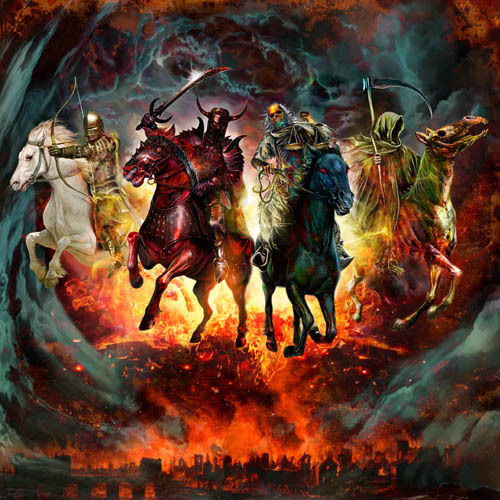
In the past, the four horsemen of the apocalypse, war, famine, disease, and death could be counted on to keep populations in check, but advances in technology, medicine, and agriculture have tipped the balance in favor of humanity.

Beyond sheer numbers, there is the problem of profligate spending that has several European nations, as well as the United States of America, in deep financial trouble. The merry-go-round of borrowing to keep bloated budgets afloat cannot continue indefinitely despite the efforts of central bankers to do so. Merely printing money has always led to bad events from riots to wars.

The financial problems are tied to the worst economic systems ever created, first as Communism, then its modified version, Socialism. Neither work. While politicians of every stripe like Socialism as a way to “redistribute” wealth, the entire system is confiscatory and based on coercion. It usually impoverishes the middle class of workers while creating an ever-growing class of those who will not or cannot work.

As harsh as Capitalism can be, it does work. It involves high levels of risk, often large amounts of investment, and it allows for failure. It is also the greatest engine of growth and the development of new industries, new technologies, and improved lives. Like fish in water, we are oblivious to the miracle a single supermarket represents.

All economic systems must strive to cope with corruption and, so long as there are three humans on Earth, there will be corruption. Having recently descended from the trees to walk upright, humans are subject to their aggressive nature.

Communism and Socialism promise equal misery. Capitalism offers the opportunity to enjoy the benefits of making the right investment guesses or developing new and better things people want to own. Competition improves life for everyone.

In sum, the clash between economic systems is still being worked out with nations that grant as much liberty as possible to their populations doing best. Where power is concentrated in a few, their populations and their nations do not prosper. As regards the world’s population, a huge cohort is young, unemployed and combustible.

It is the quest, the demand for more personal and political liberty that is causing much of the upheavals extant and no where is this more obvious than in those nations where Islam has been the prevailing religion. Islam translates as “submission.” It is based in seventh century strictures on how life should be lived. It is at war with modernity. It cannot prevail, but until it reforms or fails, there will be terrorism and war.

The greatest threat to humanity is the presence and continued quest for nuclear weapons. They are genocidal, capable of killing hundreds of thousands, if not millions. Allowing Iran, a nation led by a handful of crazed theocrats, to acquire nuclear parity poses a threat to humanity that has never existed before. Permitting North Korea or Pakistan to retain their nukes can only result in a bad outcome.

Like a rumbling volcano, the tremors felt as the result of the United States being led by a dedicated Communist and likely Muslim is a destabilizing factor not only for its citizens, but for others around the world.

It is up to the present leaders of the world to thread their way through the upheavals and divisions causing growing instability. Some will do it better than others. Some will cling to failed systems and philosophies of the past. Some will simply pursue power for power’s sake.

Alliances will change. Allies will become enemies. Enemies will become allies. Nations will pursue their shifting interests.

For the world in general, a good start would be the abandonment of the United Nations, an institution that failed initially as the League of Nations, and which is now so putrid with corruption and schemes to impose a one-world government that it poses a threat to the sovereignty of all nations.

Just as neighborhoods thrive when the common interests of neighbors for security and peace are observed, international organizations designed to concentrate power inevitably fall short of their heralded benefits.

In the same way shifts in the Earth’s tectonic plates, volcanic eruptions, and the latest cooling cycle are posing massive challenges for humanity, the nations of the world are trying to cope with changes in the financial universe they have created as well as outmoded concepts of security.

How the present upheavals, financial, religious, and demographic work themselves out remains unknown. In a neighborhood people find it best to “get along.” In a world beset with rival systems of belief and governance, the outcome is far more murky and, ultimately, more threatening.

© Alan Caruba, 2011
More aboutA World That's Coming Unglued