Showing posts with label Libya. Show all posts

Obama's Global Incompetence

Diposkan oleh Zainal Arifain


By Alan Caruba

All Presidents have had to deal with events around the world that seemed to call for a military response, but it was President Eisenhower who laid down the doctrine to avoid what he called “brushfire wars”, outbreaks such as we have seen in Tunisia, Egypt, Syria, Yemen, and, in particular, Libya.

Eisenhower had directed the defeat of Germany in World War Two as the Supreme Allied Commander before being urged to run for president. He would serve two terms and was doubtless the right man at the right time in the nascent years of the Cold War.

President Obama seems to lack any kind of a doctrine or plan to deal with a Middle East where many are fed up with its dictators, combined with the realization of how far behind the rest of the world the region is.

It is an irony of history that, after Eisenhower squelched the British, French and Israeli plans to retake the Suez Canal following Nasser’s nationalization in 1956, in rather rapid succession, Nasser died, was replaced by Sadat who was assassinated, and a 28-year-old Mubarack then ruled Egypt until the Maghreb and Middle East exploded with turmoil this year.

Why did Obama feel compelled to say anything? Earlier he was reluctant to support the Iranians protesting the ayatollahs in Tehran, but he rushed to the Tele-Prompter to tell, not ask, Egyptian President Mubarak to step aside.

Curently, the Egyptian decision to open its borders with Gaza and Hamas bodes ill for Israel, but just about everything in the Middle East right now fits that description. And, of course, Obama took the opportunity to launch a verbal attack on our only real ally in the region with an overt mention of “1967 borders”.

The payback was a joint session of Congress in which Israel’s Prime Minister Netanyahu delivered a speech to which both Democrats and Republicans repeatedly gave standing ovations. It made Obama look lame, but just about everything does these days.

Will there be a surge of democracy in Egypt? No. The military will find a way to retain power, most likely coalescing behind a new president/dictator. After that, large numbers of the Muslim Brotherhood will be jailed and killed until they crawl back into their holes.

In Libya, Obama could have simply let the resistance succeed or fail. There was no compelling reason to demand Gadhafi step aside and the embrace of “humanitarian concerns” rings hollow given events in Syria. So far the only thing that Libya has demonstrated is that NATO is ill prepared to wage a war.

Reports have it that Obama and the Russians have decided Gadhafi must go, but Assad of Syria can stay despite the fact that he is currently killing that nation’s people by the score.

Obama has returned from a European tour in which he exhorted them to give the emerging Arab states billions in aid to facilitate democracy, but Obama does not seem to grasp the fact that the only state in the Middle East that is a real democracy is Israel. The rest are controlled by dominant tribal groups in one fashion or another. They always have been and they always will be.

It has apparently escaped Obama’s notice that neither the U.S., nor any of the European nations have any money to throw at a bunch of unhappy Arabs. The Saudis have lots of money, but they are too concerned about the threat that Iran poses and too smart to get involved in the shifting sands of Middle Eastern power struggles.

The U.S. has a little problem called “a debt ceiling” to resolve so it can continue to borrow money just to pay interest on the money it already has borrowed.

Unlike Eisenhower, Obama is the wrong man at the wrong time. He is poorly advised by a pack of anti-Semites and lacks any experience, military or otherwise, to make decisions about the Middle East. His knowledge of that region’s history appears to come from brief quotes off the back of a cereal box.

In over two years in office, Obama has become a massive embarrassment to America whenever he goes abroad, whether it is to prattle about global warming in Copenhagen or to insult the Queen of England.

The result is a serious deterioration of confidence that America can be relied upon to support allies. In Eastern Europe, Poland, Slovakia, the Czech Republic and Hungary are creating a regional framework for their mutual defense, fearing that neither NATO, nor the European Union, will be of much use to them if Russia gets frisky.

And you might recall that Obama denied Poland (and Europe) a missile shield, thus sending a signal to Russia that he actually trusted them. Nobody, but nobody, trusts the Russians. And it should be noted that Iran has missles that can hit Europe.

All of this invites trouble in a dangerous world because, more and more, nobody trusts America so long as Obama is in the Oval Office.

© Alan Caruba, 2011
More aboutObama's Global Incompetence

The Middle East Mess

Diposkan oleh Zainal Arifain


By Alan Caruba

Anyone such as myself who lived through the long years of the Vietnam quagmire knows that the United States is repeating the same errors in the Middle East that we did with that nation. We seem incapable of recognizing a civil war when we see one and incapable of not inserting ourselves in the midst of it.

I speak specifically of Libya and the inchoate decisions and measures taken by the Obama administration. To suggest that the present White House and State Department have a Middle East “policy” is to vastly overstate and misunderstand their ignorance of that region of the world and the forces at work within it.

The United States has been militarily involved in Afghanistan since 2001, shortly after 9/11. What should have been a short sortie to inflict punishment on the al Qaeda and the Taliban has turned into a classic “quagmire”. The invasion of Iraq in 2003 reflects this as well.

Like many, I thought that the application of U.S. military intervention would somehow drag the Middle East into the 21st century, but clearly the region remains subject to the seventh century religion of Islam and its schism between the majority Sunnis and the minority Shiites. Islam, plus a tribalism that reaches back millennia, renders the Middle East intractable to the West’s efforts.

Billions have been squandered in Afghanistan and Iraq, while the real enemy, Iran, has been allowed to go unscathed in its pursuit of regional hegemony and its pursuit of nuclear parity with its “neighbors”, Pakistan, India, and Russia.

As this is written, Saudi Arabia has concluded that the United States will take no action to stop the Iranian nuclear program and is seeking to pull together a Gulf State coalition to end the expansionist ambitions of the Iranian ayatollahs. The Saudis have also consulted with Israel.

Forty years seems to be the limit that Middle Eastern populations will tolerate the various despots that have controlled Islamic nations. In Tunisia, Libya, Yemen, Bahrain, Egypt and Syria those in charge have found themselves under siege and, in some cases, removed.

In two cases, Libya and Egypt, the Obama administration has openly sided with the rebels. At the same time, it has incomprehensibly offered a weak defense of Syria’s dictator, Bashar el-Assad, Iran’s strongest ally in the region. Sensing a shift in power, even Egypt’s new ruling body has reached out to Iran to thaw decades of antipathy.

The only consistent Middle Eastern policy of the Obama administration has been its hostility to Israel, the region’s only democracy and America’s traditional ally since its founding just over sixty years ago. For all the caterwauling about the Palestinians, they have long since been abandoned by the Arab nations and are now well within the Iranian orbit of influence and support.

The Palestinians could have had a separate state decades ago but have always pursued an all-or-nothing policy aimed at the destruction of Israel. It is widely believed that they will initiate a new war as Iran’s proxies, from Lebanon in the north and Gaza in the south.

The Palestinians, in fact, have a sovereign nation. It is called Jordan which lost the West Bank, part of ancient Israel, to modern Israel after attacking it in 1947-48 and 1967.

Iraq has made it clear to the United States that it wants to see American troops withdrawn as agreed by the end of the year. Its Prime Minister, Nouri al-Maliki recently ordered an attack on Camp Ashraf, home to 3,500 Iranian dissidents for the past twenty-six years. That should tell even the casual observer that Iraq is now in the Iranian orbit. This is true as well of Lebanon, first occupied by Syria for decades and now in the grip of the Palestinian Hezbollah.

As to the Iranian people, the Obama administration made it clear they have been abandoned after protests against Mamoud Ahmadinejad’s stolen election last year received no support whatever by a U.S.

America has severely weakened itself since 9/11 with ill-advised military excursions that, like the Vietnam debacle, have proven costly in treasure and lives sacrificed in an area that is resentful of our unwanted incursions, coupled with our addled “nation building” schemes.

There is a massive realignment occurring as the result of the popular uprisings against despots across the North African Maghreb and the heart of Middle Eastern nations, several of which were the artificial creations of Western interests. Resentments against the tyrannies of former despots will likely give way to new despots, not democratic reform.

There is no end to the resentment against America and the West.

Lacking any kind of cohesive policy toward Arab nations except for the oil they provide, the only sensible policy America should pursue would be to drill for our own extensive oil reserves to prevent a severe shock to our economy and security. So long as Obama is President, this will not happen.

There is no perceivable policy in place to stand against Iran and has not been since the Carter administration abandoned the Pahlavi regime in 1979. The fall of Tunisia’s Zine El-Abidine Ben Ali, Egypt’s Mubarack, Syria’s Assad, and the resistance to Gadhafi, along with unrest in Yemen and Bahrain will be seen, in retrospect, as inevitable.

What remains is a Maghreb and Middle East in a volatile struggle to determine whether it returns to an Islamism reminiscent of the Ottoman Empire or an enlightened embrace of Western values.

There is little reason to hope for a good outcome.

© Alan Caruba, 2011
More aboutThe Middle East Mess

War for No Particular Reason

Diposkan oleh Zainal Arifain


By Alan Caruba

Thanks to the Obama administration, we have now entered upon a new phase of foreign policy. It is war for no particular reason.

Why are we doing anything in Libya? We’re not messing around in any of those other places that involve governments shooting at their own people. Obama famously did not want to “meddle” when the Iranians filled the streets of Tehran in 2009, protesting a stolen election by Mamoud Imanutjob and Ayatollah Comeandgetme.

Americans are connoisseurs of invasions. We know a good one when we see it and are not easily fooled by those who say, “We’re dropping thousands of pounds of ordnance and launching numerous missiles, but we are not in a war. It’s a kinetic military action.” Yeah, right.

Telling Americans that their nation—without so much as a phone call to Congress—has launched a military action over (but not IN) Libya and that NATO is really running the operation, (with a Canadian general taking orders from two American generals) suggests that the White House thinks we are really STUPID.

We know what an invasion looks like. Bush41 had a great one in Kuwait and Bush43 had an even better one in Iraq. It may not have been D-Day, but it was good enough for a generation born too late to remember Normandy Beach. When it comes to invading countries, we are the gold standard.

Conservatives wonder why the liberals screamed bloody murder when Bush43 invaded Iraq after getting all kinds of UN resolutions and authorization from Congress, but are curiously silent when Obama begins bombing the hell out of Tripoli “for humanitarian reasons.” Of course, in fairness, liberals never want to invade any place. That’s why you don’t find many liberals in the Marines and other branches of service.

How do you tell a good despot from a bad one? Let me explain. There are the pro-U.S. ones who cooperate with us and there are all the others. As some statesman once said, nations have interests, not friends.

It is necessary to understand that those generating an Islamic revolution have no love for the monarchs and the former colonels and generals who run Muslim nations. Their ideal is something like Iran. The initial goal of al Qaeda, for example, was (and is) to overthrow the ruling family of Saudi Arabia. They, in turn, told bin Laden to get out and stay out.

The present unrest in Muslim nations is the result of the convergance of al Qaeda and Iranian agendas to exercise control over those nations. But first, they intend to destroy everyone, Jew, gentile, and Arab alike, in Israel. According to Islamic lore, they can’t really take over the world until this is accomplished.

Americans have been slow to grasp that the Iranians have been preparing since 1979 to sweep across the region and the world to ensure that Islam (Shiite version only) is the only religion with the power to dictate to all others. There is zero room for tolerance in Islam, a “religion” that separates the world into dar al Islam and dar al Harb (the world of war!)

As a non-war the Libyan operation is especially disappointing since the so-called rebels at this early point have less cohesion than a Hell’s Angels chapter. This has not deterred talk of “arming” them. However, the latest word out of Libya is that the “rebels” made a couple of million by selling thousands of mustard and nerve gas shells they found in military facilities around Benghazi to the Palestinian terrorist organizations, Hamas and Hezbollah. Let those creeps arm themselves.

How was it that a President who spent weeks agonizing over what to do in Afghanistan took only a few days to decide that the U.S. should start lobbing missiles into Gadhafi’s Libyan compound?

One obvious answer is that the man is just a moron. The other is that he lacks any serious opposition from Republicans and Democrats alike, and for now is being allowed to get away with it.

The U.S. Navy and Marines showed up in Tripoli in 1801 to deal out some hurt and a message to the Barbary pirates harassing our merchant ships. President Thomas Jefferson concluded that killing the pirates was cheaper than paying them the bribes they demanded. He was right.

The rebellion against Gadhafi appears to have a contingent of jihadists that include al Qaeda’s professional mujahideen that migrate from war zone to war zone, but the bottom line appears to be that folks throughout the Middle East are just fed up with the current crop of despots. Forty years in control seems to be the cut-off point whether it was Egypt’s Mubarack, Libya’s Gadhafi, or the former Tunisian tough guy, Zine el-Abidine Ben Ali.

This Libyan non-war reeks of having been a political decision. It is surely not a military one. Odds are that Obama is not paying attention to what his generals are telling him and it’s for damn sure he doesn’t care what the U.S. Constitution has to say on the subject.

No one knows how this kinetic farce will play out, but since Obama is channeling Jimmy Carter, there is a strong likelihood the U.S. is going to end up looking bad and events in the Middle East will just get worse.

© Alan Caruba, 2011
More aboutWar for No Particular Reason

The Education of Barack Obama

Diposkan oleh Zainal Arifain


By Alan Caruba

Just over two years ago when Barack Obama was sworn into office, he might have needed help to find Libya on the map and Muammar Gadhafi was just another Middle Eastern despot.

Despite a whirlwind tour of the Middle East, I doubt he had any idea that the Maghreb of north African nations, from Tunisia to Egypt, or that Syria, Jordan, Yemen and Bahrain would be in varying states of turmoil, but neither did anyone else. He had little to say during the protests against Iran’s mullahs.

The last thing Obama wanted was to be a “war President.”

Even in his address to the nation regarding the U.S. intervention in Libya, he could not resist chiding his predecessor. “To be blunt, we went down that road in Iraq,” he said without naming George W. Bush, his favorite fall-back position for blame. Then he added that the war in Iraq has lasted eight years, cost thousands of lives, and a trillion dollars. The one in Vietnam lasted almost as long and was just as costly.

Unmentioned was his decision to not only remain in Afghanistan where the U.S. has been since 2001, but he increased our troop strength—just as former President Bush did with the “surge” that turned things around in Iraq. The result of Obama’s decision has been to keep al Qaeda on the run and a continuing effort to degrade the Taliban. Unsaid is the fact that guerrilla wars are generally long, drawn-out, and often inconclusive.

The conduct of war is the job the Constitution assigns to the President by also authorizing him to be the Commander-in-Chief. Obama, the community organizer, is uncomfortable with this responsibility, but he put those skills to use to pull together a coalition, get a U.N. resolution, and let loose the dogs of war, if only from the skies.

What he failed to do was consult with the Congress and either ask for or get a resolution of support. He’s supposed to do that, but the former university lecturer on the Constitution either forgot that or decided to ignore it. That, however, is a very bad precedent.

“I refused to wait for images of slaughter and mass graves,” he said and, frankly, I believe him. He drew on the lessons of former President Clinton’s difficulty to get the U.S. involved in stopping the ethnic cleansing in Serbia and Bosnia.

The reluctant war President, however, took pains to tell Americans that “The U.S. will play a supportive role” in Libya’s liberation and only the seriously uninformed could believe that tall tale. There is no military action in Libya without the U.S., now and into the unknown future.

In almost an aside, Obama spoke of Iran, “where change is fiercely oppressed.” He hasn’t had much to say of Iran and this suggests he wanted to send some kind of message to the ayatollahs that he was keeping an eye on them as he should. They are gearing up to make events infinitely worse in the Middle East.

What Obama has discovered—and should have known—is that America has been the world’s policeman since the end of World War II way back in 1945. It’s the reason that former President Truman ordered U.S. troops into the field when North Korea attacked South Korea. It’s the reason Americans happily elected a former five-star general, Ike Eisenhower, to guide the nation when he promised “I will go to Korea” to personally inspect the demilitarized zone.

“We should not be afraid to act,” said Obama regarding the various unpleasant choices we have before us and those that are sure to come and then he emphasized “collective action”, falling back into his favorite role as an organizer, rather than a warrior.

In truth, Obama is not a warrior. Unlike many prior presidents he never wore the uniform of his nation and he clearly finds war distasteful, a distraction from imposing domestic change on Americans who have proven resistant and who are likely to send him home to Chicago in 2012.

“We welcome the fact that history is on the move in the Middle East,” the President said. Somehow I doubt that. For decades this nation has been more than happy with the status quo in the Middle East so long as the oil flowed. Those days are over.

It was a decent enough speech that touched on all the key points. Gadhafi is a despot. He threatened his people. Our interests and values are at stake. All the things one would expect him to say, but none of the fire, the “bring’m on” swagger we have missed since 9/11. Like him or not, George W. Bush made us feel safe. Obama makes us feel tentative.

America has real enemies and, frankly, I want them to be very afraid of us. They were once, but when even a cockroach like Gadhafi thinks we won’t or can’t kill him, I want his head on a pike for all the rest of the world to see.

© Alan Caruba, 2011
More aboutThe Education of Barack Obama

Protests, Riots, and Insurrections

Diposkan oleh Zainal Arifain


By Alan Caruba

I’ve been thinking a lot about protests, riots and insurrections lately because they seem to be happening all over the Middle East and even in London.

In London, an estimated half million Brits turned out in the streets to protest government cuts in services, paying little heed to (a) how heavily they are taxed for them and (b) how they have all but bankrupted the nation. Though the protest was at times raucous thanks to local anarchists, it should be noted that the local constabulary did not shoot anyone.

Contrast that with the streets of Yemen, Syria and even little Bahrain where protests have generated a number of deaths as the main means of “crowd control.” This is also the way protests in Iran have been dealt with, along with imprisonment, torture, and all the other arts of despotism.

In Libya, an insurrection against four decades of despotic rule by Col, Gadhafi has dragged in the U.S., the U.N., NATO, and, briefly, the Arab League into the dispute. Given that Gadhafi had made it clear he intended to kill as many Libyans as necessary to retain his grip on the nation, there was no way this could be ignored.

By contrast, when a huge crowd gathered in Tahrir Square in Cairo the military did not roll out the tanks. After a few futile efforts to disperse the protesters, President Mubarak was eased out of the office he had held since 1981 and sent packing. All things considered it was a bloodless coup. The Egyptians just held an election to decide some changes to their constitution.

Other contrasts come to mind, most notably, the 1989 massacre that took place at night in Beijing’s Tiananmen Square when protesters, mostly young Chinese, gathered to seek more freedom, more justice, and more democracy. It did not happen. While outwardly prosperous, China remains the classic Communist state.

One of the biggest gatherings in the U.S. capitol involved an estimated million people who came out in March 2010 to protest against the passage of Obamacare. It was an extraordinary turnout and one that the mainstream media tried to depict as unruly and impolite, but it was nothing less than astonishing that so many people could gather in one place without any disruptive behavior. David Axelrod, an advisor to Obama at the time, gave the White House response. “They’re wrong.”

When Obamacare was passed, the Tea Party that had organized the protest just grew like Jack’s beanstalk and, by November 2010, lots of Democrats who had voted for it found themselves cast out of the House, along with some in the Senate. Americans know how to protest, how to organize, and how to vote out liberals.

The differences between American, British, and Middle Eastern protests are quite evident. In the former two, you show up, speeches are given, and everyone goes home. In the latter, you show up and the regime in charge is likely to shoot you.

In America it was the Boston massacre that literally kicked off the Revolution against England in general and the king in particular. British troops, feeling threatened, fired on a relatively small group of protesters and, as they say, the rest is history.

The history of what is occurring in the Middle East is playing out in its cities and, while the region is not famous for democratic reform, the U.S. intervention in Iraq to depose Saddam Hussein may well be seen in retrospect as the trigger for all the insurrections occurring throughout the region. Before the Marines and infantry showed up, you could only vote for Saddam.

The trigger incident in Tunisia occurred when a street merchant, harassed by the local police, set himself on fire, but it really doesn’t matter what the trigger is because it is the far larger resentment of the populations in the nations of the Middle East that has finally been ignited.

The other largely unreported factor is the deep schism between Shias and Sunnis. It expresses itself in different ways in different nations. Sunnis are the majority or control the affairs of most nations except Iran.

The old regimes are being challenged. If you are a monarch the last thing you want to see are other monarchs being dethroned. If you are a despot, you can be replaced.

What will come of it? Is it good or bad for the United States and the West? Will the Muslim Brotherhood and/or al Qaeda take advantage and somehow secure power?

Questions, questions, questions!

And no one knows the answer.

© Alan Caruba, 2011
More aboutProtests, Riots, and Insurrections

Obama Prepares for Speech on Libya

Diposkan oleh Zainal Arifain


Barack tries out the magic ruby slippers that will enable him to escape the "kinetic military action" occurring in Libya while explaining to everyone why it is not a WAR and is really being conducted by a combination of NATO and the United Nations. Go for it, Barack, I cannot wait to hear this one.

h/t to TerrellAfterMath.com
More aboutObama Prepares for Speech on Libya

A World in Disarray

Diposkan oleh Zainal Arifain


By Alan Caruba

It almost makes one wistful for the Cold War when the world was neatly divided between the United States and its allies against what Ronald Reagan called “the evil empire”, the Soviet Union and its satellite nations.

Trying to bring about a League of Nations after World War One virtually killed President Woodrow Wilson who suffered a massive stroke, but liberals have always been entranced with the notion that an international organization would bring an end to war. Until, that is, World War Two.

As WWII was winding down, Franklin Delano Roosevelt set to creating the United Nations and, following his death, it came into being on June 26, 1945. The preamble to its charter says:

“We the people of the united nations determined

to save succeeding generations from the scourge of war, which twice in our lifetime has brought untold sorrow to mankind, and

to reaffirm faith in fundamental human rights, in the dignity and worth of the human person, in the equal rights of men and women and of nations large and small, and

to establish conditions under which justice and respect for the obligations arising from treaties and other sources of international law can be maintained, and

to promote social progress and better standards of life in larger freedom,”

Yada, yada, yada!

The United Nations has devolved into a cesspool of evil and irrelevance. I cannot think of a single war, large or small, nor any genocides, it has managed to stop. There were a couple of military conflicts in which it was an active participant, mostly in the form of telling the United States to “go get’m!” and “don’t forget to wear our blue helmets.”

If there has been a force for freedom in the world, it has been the might and power of the United States of America.

Until now.

Now our President says, “No U.S. troops will be in Libya.” This administration is desperately looking for some other nation to take the lead on Libya.

Let me be clear. I have not been a fan of spending our treasure and blood for the people of the Middle East. I am not a fan of war, but I know that war is the only way that most international conflicts get settled for good or ill.

The last President, George W. Bush, put together a coalition and invaded Iraq because, well, because he really did not like Saddam Hussein who, incidentally, had been invading his neighbors since the 1980s. His father had previously done the same to drive him out of Kuwait in the first Gulf War.

If there ever was a coalition regarding Libya, it was made of sugar candy because Germany and France had serious second thoughts after a week. No fly zones, it seems, cost a lot of money to maintain and most Western nations are broke, including our own.

The Arab League that called for a no-fly zone over Libya ran away even sooner. Arabs, who have shown an unparalleled talent for killing one another, lack the stomach for anything that involves mounting a real war to stop one of their own from killing the unfortunate citizens of his satrapy.

As it is, alphabetically from Bahrain to Syria to Yemen, despots throughout the Middle East are busy right now putting down their own internal insurrections. In the late 1990s Osama bin Laden gained a lot of attention by calling for the downfall of all the monarchies and despots throughout the region and the implementation of sharia law in anticipation of a global caliphate. The Saudis exiled him as they thought this was a really bad idea despite being the protectors of Islam’s two holy cities of Mecca and Medina.

At the same time we are witnessing a remnant of the Cold War, NATO, that does not seem to be functioning all that well, nor the European Union that was formed to be an enconomic bloc and clearly not one with any kind of a military component or sense of mission.

What the world needs is decisive leadership, but instead it has the Hamlet of the White House, Barack Hussein Obama, whose initial tour of the Middle East has, in retrospect, turned out to be one that caused its despots to conclude he was a wuss, a naif, a moron.

Who’s in charge of Operation Free Libya? No one knows!

The result is a world in disarray because the one nation every other nation thought it could count upon, for better or worse, is led by the Vacationer-in-Chief, a man who thinks that merely “saying the right thing” is the same as “doing the right thing.”

The situation in Libya will not likely turn out well, nor the growing opposition in Syria. No one knows what the outcome in Egypt will be, but everyone is pleased the crowds in downtown Cairo have gone home.

Meanwhile, Hamas is gearing up to cause trouble in Israel, waging its usual Made-in-Palestine terrorism based on the Yassir Arafat Guide to Always Saying No.

It is my profound hope the Israelis will strike back very hard, but it is also my profound belief that the UN Security Council will hastily meet to pass another resolution against Israel taking any measures of self defense.

This is how really big wars break out because no one at this point wants to fight the small ones.

© Alan Caruba, 2011
More aboutA World in Disarray

Teeny, Tiny Wars

Diposkan oleh Zainal Arifain


By Alan Caruba

On the same day that the U.S. had blown up a building on Gadaffi’s compound in Tripoli, the news out of Iraq was as follows:

Baghdad (3/21/2011) – Aswat al-Iraq: Iraqi Prime Minster Nouri al-Maliki considered on Monday Iraq as one of the most stable countries in the region. Addressing a gathering attending the third agricultural week in Baghdad, the premier said, “Iraq became one of the most stable countries in the region after a period of violence and divisions.” He urged ministers to speed up solving all problems and improving services to Iraqis. Demonstrations sweep a number of Arab countries, mainly Libya, Syria and Yemen, calling for toppling regimes and achieving political reforms.

THANK YOU, UNITED STATES OF AMERICA!

How ironic is it that a war that many Americans now regard as a mistake is, from the Iraqi point of view, one that has led to an era of stability?

Military observers and historians regard wars differently than civilians. The terms they use are “high intensity” and “low intensity.” As Sean Linnane, editor of the Stormbringer blog notes, “In the eight years of Iraq, we lost just as many people as we lost in a single day at Normandy. By the same standards, Vietnam was a low-intensity conflict. We lost just under fifty thousand over ten years, whereas we lost that many in three years in Korea and in three days at Gettysburg.”

Linnane explains how the technology of modern war has changed the way it must be understood. “An infantryman with a shoulder-fired weapon negates a 55-ton tank.” Such weaponry allowed Stone Age mujahideen in Afghanistan to defeat the Soviet Union.

“While at the same time,” Linnane correctly points out, “the amplifying effect of the modern media allow tiny symbolic conflicts to gain great meaning.”

I am beginning to think that any action or no action that President Obama took would have satisfied anyone because we Americans feel it is our constitutional right to criticize the President and it is!

Obama has been getting a crash course in foreign affairs for two years. Before taking office, he was your average intellectual airhead, full of theories and Marxist dialectics, and having no clue what the job required. By contrast, George W. Bush had grown up around the office his whole life and, if you recall, his father had actually been President.

Surrounded by political advisers, generals from the Pentagon, so-called national security people, State Department folks from Foggy Bottom, and other interested, partisan parties, Obama has had to learn how to become “the decider” like Bush43. For Obama who has basically voted “present” in public life, that has neither been easy nor welcome.

What Obama discovered was that, if he just did what Bush had done for the eight previous years, it would probably be the wisest course of action. So Guantanamo is still open for business and Obama even increased U.S. forces in Afghanistan. The withdrawal schedule for Iraq was already in place when he arrived in the Oval Office, so he cannot take credit for that.

There’s a really good reason for pulling our troops out of both Afghanistan and Iraq and, if possible, sooner rather than later. A lot of them have been rotated in and out of both locations so many times they are just bone tired and thoroughly disgusted with the people for whom they have been trying to provide a shot at freedom, democracy, or whatever passes for life without some dictator or Islamic fanatic trying to kill them.

In a very real way, both Bush’s set in motion the Middle East tumult by demonstrating that dictators can, indeed, be overthrown. The Arab street may say it hates America, but it looks to it to come swooping in to defend and save them.

For many years to come, the whole of the Muslim countries stretching across northern Africa and the Middle East are going to be a working definition of bedlam. To name a few, in addition to the recent demands for less repression in Egypt and Tunisia, plus the present unpleasantness in Libya, the following nations are seeing similar popular discontent—Bahrain, Yemen, the Sudan, and Somalia.

In trouble to a greater or lesser degree, there’s Saudi Arabia, Iran, Syria, Jordan, Kuwait, United Arab Emirates, Algeria, Morocco, Pakistan, and the hate-filled denizens of the West Bank and Gaza, the Palestinian Authority and Hamas. Poor Lebanon has labored under the fist of Syria and now Hezbollah.

By comparison, Israel is an island of peace as is Qatar, and, dare we say it, IRAQ!

All of which means a succession of teeny, tiny wars over the years ahead, some of which the U.S. will choose to engage to a larger or small extent. We will not let any ill befall Saudi Arabia because it has a lot of O-I-L. Other oil states will likewise get varying levels of protection. Gadaffi was denied this because of his history of crimes against the U.S.

Americans will, as they always have, hate having to engage in any of these predictable conflicts, but we shall, even if it means that this president and future ones will have to do a two-step around the Constitution and War Powers Act. The dirty secret in Washington, D.C. is that no Congress since World War Two (1941) has actually declared war because they are essentially political cowards who don’t want the blame if anything goes wrong as in Vietnam.

If the U.S. wasn’t totally broke and totally unwilling to cut taxes and spending, we might actually be able to afford some greater effort to help keep the world safe, but for now, we shall have to stick to Tomahawk missiles and other such devices to inform our enemies that we want them dead.

Did I mention that Iraq is stable? No war going on there? A democratic regime in power? I can hear George W. Bush laughing all the way from Houston.

© Alan Caruba, 2011
More aboutTeeny, Tiny Wars

Libya, a Jolly Short War

Diposkan oleh Zainal Arifain

By Alan Caruba

There’s nothing like a war to either make or break a President. There’s a reason the writers of the Constitution also made the President the Commander-in-Chief because war needs a centralized authority to direct the military. A goodly number of the nation’s presidents were former leaders in war, starting with General George Washington, progressing forward to General Ike Eisenhower.

Few nations have the record of its people being extraordinarily resistant to engaging in combat unless provoked than America. Woodrow Wilson was elected with the slogan “He kept us out of the war” and then, after the Germans had the bad judgment to sink the ocean liner Lusitania, America sent “Black Jack” Pershing to put a finish to World War One.

Franklin D. Roosevelt, having made a thorough botch of the Great Depression, was propelled into war by the attack on Pearl Harbor. Until then, Americans wanted nothing to do with another “European war” or the one being waged in Asia. FDR had the good luck to be guided by Gen. George C. Marshall.

Time and time again, U.S. Presidents have had to engage in war and almost always under circumstances that involved a large part of the population being opposed to it. There is something about “modern” wars that means we end up staying on far too long after we’ve dropped the bombs, let lose the artillery, and sent in the Marines and infantry.

Like the Romans of old, Americans do not like protracted wars and, worse, they tend to weaken a nation or an empire. The irony for the Romans is that, as often as not, they were invited by the host nation to keep the peace. Indeed, that’s how the term “Pax Romana” came about. And just as often the locals got tired of the Romans and revolted against them.

It is common knowledge that it’s easy to get into a war, but hard to end one. We are in Afghanistan, not because we started a war with Osama bin Laden, but because he had declared war against the U.S. in 1996, tried to blow up the Twin Towers in 1993, and then waited until 2001 to do it again. George Bush’s response was to bomb the hell out of Tora Bora in Afghanistan and, initially, to drive the Taliban out of there.

Then, on the theory that democracy could be exported to Iraq and because Saddam Hussein was going to make trouble so long as he drew breath, Bush junior decided to invade, perhaps having drawn the lesson from Bush senior’s decision to leave Saddam in power after the first Gulf War, one he later regretted.

In Afghanistan, “mission creep” set in and Bush stayed on. Now President Obama has stayed on. The United States of America has been an occupying force in Afghanistan longer than the former Soviet Union. That does not suggest a good outcome to me because one of the taunts of the Pashtun tribal members is “You have the watches, but we have the time.”

So let it be said, Obama has probably made the one and only really good decision of his presidency. He has made it clear that no American troops will be among the “boots on the ground” when it comes to ridding Libya of Gaddafi. At a time when the U.S. military is in Afghanistan and Iraq, albeit with timetables to leave, we can quite literally ill afford a third war in the Middle East.

If we have to defend the Saudi oil fields—which we may have to do—the Saudis can afford to pick up the bill and had better be handed one. Meanwhile, their military are busy helping put down protests in nearby Bahrain. The prospect that there will be all manner of protests throughout the Arab region of the world is now guaranteed.

The one in Egypt ended remarkably well with a bare minimum of dead Egyptians. The Tunisian overthrow of its dictator went swiftly and smoothly. Dare I remind the reader that both nations were led by men who were U.S. allies? Things are a tad shaky for another longtime ally, King Abdullah of Jordan, who has the evil Syrians as neighbors and a huge Palestinian population.

Flying well under the radar of U.S. media, on March 15, Israeli commandos intercepted a ship from the Turkish port of Mercin that was headed to Egypt’s Alexandria, loaded with weapons for Hamas in the Gaza. The ship had initially departed from Syria en route to a stop at a Turkish port. Turkey used to be an ally of Israel. (See YouTube IDF video) Formerly Egypt would never have allowed Hamas to get weapons. Also under-reported were the estimated fifty rockets fired into Israel from Gaza on March 19. The Israelis responded with a quick, lethal air strike.

You don’t have to be a CIA analyst to conclude the weapons were all made in Iran or at least transferred from there initially. Or that Israel will face another war at some point. If they nuke targets in Iran, it should be over fairly quickly, but they will still be facing Hezbollah in the north and Hamas in the south.

Like the Romans, the U.S. needs to extricate itself as much as possible from the Middle East unless its vital interests are threatened there. By which I mean, unless we have to defend Iraq’s, Saudi Arabia’s, Bahrain’s, Kuwait’s, and the United Arab Emirates’ oil fields. Defending the region’s only Western democracy, Israel, is also a good idea.

For the same reason that President Obama elected to let the British and French take the lead in Libya, we have ample firepower from the skies and from offshore naval forces to do much of the damage that may be required in what is likely to be a jolly good, but limited military operation in Libya and likely future conflicts.

There isn’t a single military figure among any of the potential candidates in the next election. What we need in the years immediately ahead may well be a President Petraeus.

© Alan Caruba, 2011
More aboutLibya, a Jolly Short War

Give the Peace Prize Back, Barack

Diposkan oleh Zainal Arifain


By Alan Caruba

As the Middle East begets one insurrection after another against the oppression that has been endemic to the region for centuries and as Japan faces the worst nuclear energy disaster since Chernobyl, the President of America and Commander-in-Chief is Absent Without a Leave (AWOL).

Barack Hussein Obama is the first President of the United States who received a Nobel Peace Prize just for showing up. It is a mark of how debased this once prestigious international prize has become. He should give it up.

In the past, the Peace Prize went to Theodore Roosevelt in 1906 for negotiating an end to a Russian-Japanese conflict and to Woodrow Wilson in 1919 for his efforts to create the League of Nations. Its value began to fall off the cliff when it was given to Jimmy Carter in 2002 and Obama in 2009. In between, it was awarded to former Vice President Al Gore and the UN’s International Panel on Climate Change in 2007.

It is an ancient axiom that power is lost when power is not exercised. Osama bin Laden seriously misread the U.S. when he referred to it as “a weak horse”, an Arab way of saying it could be attacked with impunity. George W. Bush responded by bombing the hell out of Tora Bora in Afghanistan and then by invading Iraq to depose Saddam Hussein. Bin Laden has been in hiding ever since and his top lieutenants keep getting whacked.

Obama’s approach to foreign affairs has been to misunderstand and denigrate the role of America in a dangerous world. Daniel Henninger of The Wall Street Journal calls it “The Collapse of Internationalism” because the failure to lead has demonstrated the uselessness of the United Nations, its Security Council, NATO, the European Union, and the Arab League when it comes to facing down a psychopathic despot like Libya’s Quadaffi and, of course, the same was true regarding Saddam Hussein.

This is how big wars occur.

Recent history bears out the failure to take action against Mussolini’s invasion of Ethiopia, against Adolf Hitler prior to his invasion of Poland, to anticipate the sneak attack on Pearl Harbor, and now the inevitable acquisition of nuclear weapons by Iran.

This is what happens when an administration’s policy makers are all “intellectuals” who have spun out hypothetical views of the world that have no relationship to history or present realities.

This is what happens when, despite our present financial woes, the most powerful nation on Earth has reduced its naval and air power, and asks its military to engage in nation-building while fighting our enemies. What is needed are entirely separate, highly trained units devoted to that task.

This is what happens when “foreign policy” involves wasting billions of taxpayer dollars on the United Nations and billions more in so-called “foreign aid” to nations that do not like us, nor support us in times of crisis and need.

Libya, said Henninger, “was a test case, and what we have seen is that a world in which the U.S. doesn’t unmistakably lead is a world that spins its wheel, and eventually the wheels start to come off.”

The U.S. is not, as Obama believes, just one more nation among others or that it is not the single most exceptional experiment in democracy and freedom.

Just as Americans must organize to resist and survive Barack Hussein Obama over the next two years, having come to realize how utterly incompetent he is, other nations are wondering what will occur without the leadership the U.S. has always provided in the past, including two world wars, several smaller ones, and the containment of the former Soviet menace.

The presidency is much more than frequent trips to the golf course, predicting the outcome of the NCAA tournament, and an ill-timed visit to Rio. It is a dangerous place filled with people like Quadaffi and others of his ilk.

© Alan Caruba, 2011
More aboutGive the Peace Prize Back, Barack

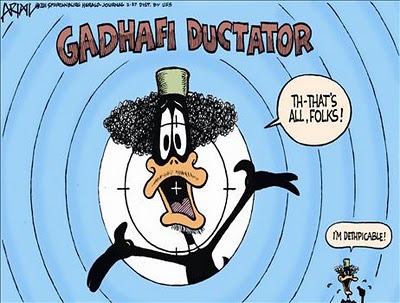
Gadhafi Ductator

Diposkan oleh Zainal Arifain

More aboutGadhafi Ductator